Two languages from early childhood: will my child get confused?
Does a child get confused by two languages, does it delay speech, and is mixing words normal? What research says about bilingualism at ages 2–6.
"Maybe one language properly first, and then the second?" Parents ask this question very often, especially in Tashkent, where many children hear Uzbek and Russian at home, and now English as well. Parents want to give their child more, but they worry about overloading them: will the child get confused, start talking later, begin mixing up words?
Bilingualism in early childhood has been studied for decades, and researchers have answers to these concerns. Below we look at each of them in turn.
"They will get confused"
Two researchers from Canada and the US, Krista Byers-Heinlein and Casey Lew-Williams, brought together in a review what science knows about bilingualism in early childhood. Their conclusion is clear: children who grow up with two languages tell them apart well and do not get confused. Children are born ready to learn the languages around them, without confusion and without delay (Byers-Heinlein and Lew-Williams, 2013).
Materials for parents prepared on the basis of the expertise of the American Speech-Language-Hearing Association (ASHA) reach the same conclusion: several languages do not confuse a child or delay speech development.
"They mix up words. Is that bad?"
A phrase like "дай мне juice" ("give me juice") sometimes worries parents. However, mixing words from two languages in one sentence is considered a normal part of bilingual development. Most often a child borrows a word from the other language when they do not yet know, or cannot recall, the one they need.
"They will start talking later"
There is one subtle point here. If you count words in only one language, a bilingual child often knows fewer of them than a peer growing up with one language. If you add both languages together, the total vocabulary of these children is about the same (Hoff et al., 2012).
In other words, the child is not falling behind: their words are simply shared between two languages.
The timing of first words does not shift either. Most bilingual children, like their peers, say their first words at around one year old and begin putting words together into phrases by two (from materials based on ASHA expertise).
There is one more observation. Speech difficulties and developmental delays are no more common in bilingual children than in others. If a child does have speech difficulties, they will show in all of the child's languages, and bilingualism will not be the cause. Parents of such children are sometimes advised to drop the second language, but research does not support this advice.
What really helps
Researchers agree on the main point: what matters most is how much of each language a child hears, and in what kind of interaction.
- Amount. Children's language developed better the larger the share of time they heard it. A couple of hours a week, for example a weekend club, is unlikely to get a child speaking.
- Real conversation. Quality matters too: talking, playing, sharing a book with an adult. Cartoons cannot replace real conversation.
- Different people to talk to. In one study, two-year-olds' English was better when several different people spoke it with them (Place and Hoff, 2011).
- Speak your own language. Materials based on ASHA expertise advise speaking to your child in the language that feels comfortable and natural to you. A strict "one parent, one language" rule is not essential: any approach works as long as the child hears plenty of each language, and hears it well.
There is also a word of caution. The bilingualism researcher Ekaterina Protassova, who has studied multilingual children, advises making sure that at least one of a child's languages is fully developed, at the level of their peers. Problems arise when there is too little of each language around the child and none of them becomes the main one.
Is earlier better?
On the whole, yes: young children easily absorb the language they hear around them. A bilingual kindergarten provides what is hard to arrange at home: plenty of living language. But language needs to be kept up afterwards: without practice, the skill fades over time.
How it works at Oxbridge kindergarten
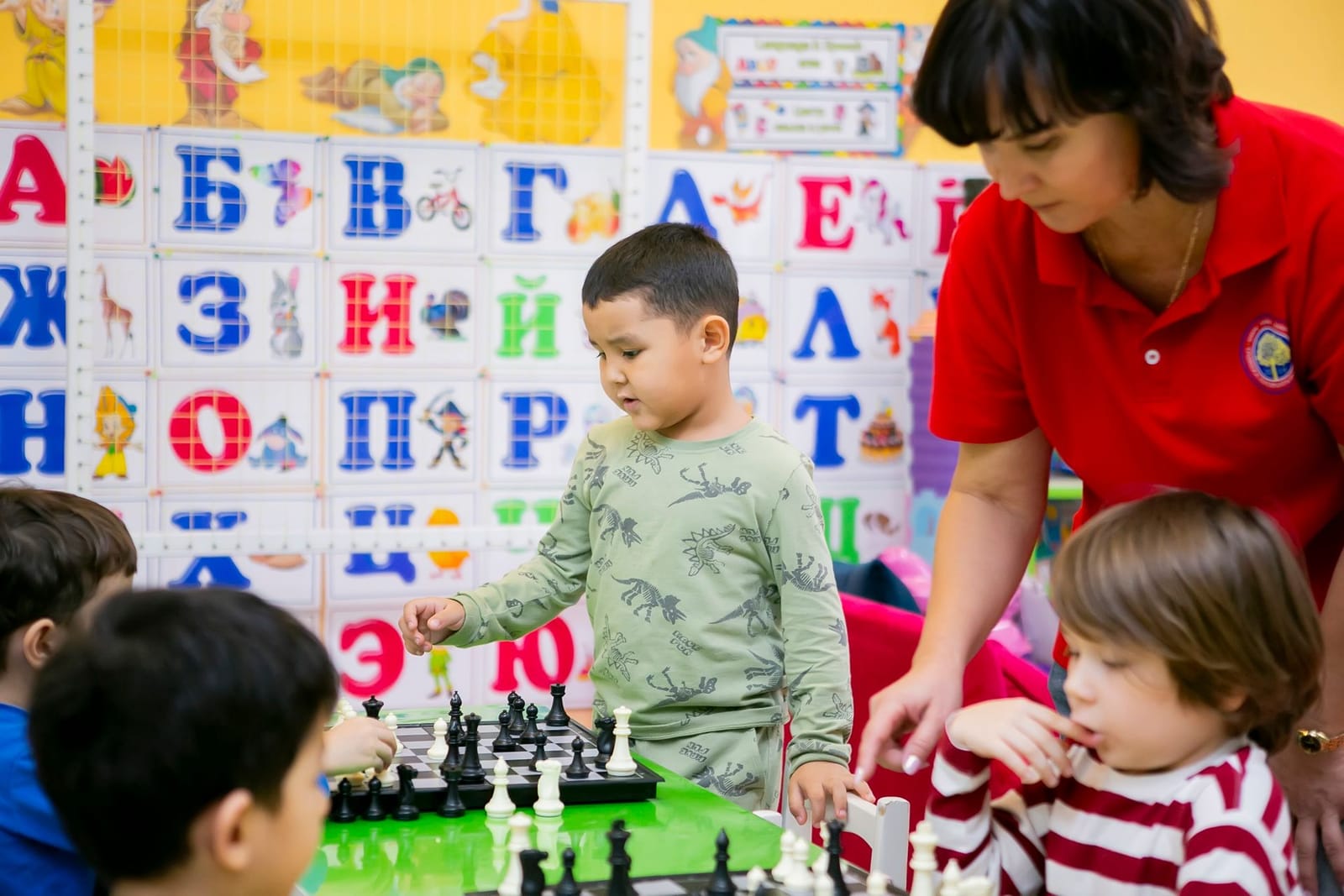
Our kindergarten is bilingual from the very first day. Russian and English flow together: in conversation, in books and in everyday communication throughout the day.
English is woven into the daily routine: songs, stories and real conversation with an expat teacher. This way children get what researchers write about, plenty of living language, and by the time they start school English has become familiar to them.
- Ages 2–4, Early Development. Speech develops in two languages at once, through play, songs and books.
- Ages 4–7, Active Development. Daily bilingual immersion, alongside preparation for reading and counting.
- From age 5, IB Preschool. For families who choose an international education: the whole day fully in English.
Parents often notice the first results at home: a child brings home new English words.
After that, a child can continue at Oxbridge school, right here: in the Russian programme, where from Grade 5 English is taught in groups of up to 8 pupils, or in the IB programme in English. This way the language that began at kindergarten is not lost.
You can read more about our groups, programmes and fees on the Oxbridge kindergarten page.
Advice for families who speak Uzbek at home
If you speak Uzbek at home, carry on. Research gives no reason to give up your home language for the sake of a new one. A child needs plenty of real conversation in each language, and at home it is best to speak the language in which you yourself find it easy to talk, read fairy tales and discuss important things.
Frequently asked questions
Will my child get confused if there are two languages at kindergarten?
No. Research shows that young children tell their languages apart and do not confuse them. Mixing words in one sentence is a normal part of bilingual development.
Can a second language delay speech?
No. Bilingual children say their first words at about the same age as their peers, and speech delays are no more common among them. If you add up the words in both languages, their vocabulary is the same as their peers'.
Do we need to speak English with our child at home?
It is not necessary. Specialists advise speaking to your child in the language that is comfortable for you. Your child will get English at kindergarten, through real conversation with the teachers.
We invite you to come on a tour: we will show you how the two languages are used in our groups and introduce you to the teachers.
Book a tour